Saturday, 16 June 2012
Hellraiser 2: Hellbound
A bold sequel with an ambitious yet awfully muddled script. The gore factor here is much higher than in the original and there are some frankly horrific and disturbing sequences which could perhaps best be described as upwardly ‘nasty’. Unfortunately, director Tony Randel doesn’t pull this one off at all and Hellbound collapses in on itself about half-way through proceedings amongst a plethora of absurd plot moves, incoherent story-telling and ridiculous special effects.
There are positives, such as stage-actor Kenneth Cranham’s portrayl of the pleasure-seeking ‘Dr Channard’ and Doug Bradley’s touching memories of ‘Pinhead’ in human-form. Such moments are regrettably few and far between in a film which foregoes the claustrophic setting of family-life in Barker’s original in order to chase some broader ‘good VS evil’ plot device. For me, the film fails miserably in this vision and ends up being nothing more than a hugely disappointing collage of blood-soaked set-pieces.
Labels:
Grant Davies,
Hellraiser
Hellraiser 3: Hell on Earth
This is a film which thrives on over-whelming violence and stunning visuals whilst watering-down the erotic mysticism of the earlier movies in the series. You get the feeling that Pinhead is edging closer to the standard cinema ‘boogeyman’ (Freddy Kruger, Michael Myers etc.) as his killing-spree becomes increasingly indiscriminate. Nevertheless, Anthony Hickox’s direction is both fluid and punchy enabling the movie to hurl itself towards an aesthetically-pleasing finale. Doug Bradley’s performance as the human ‘Pinhead’ is great to watch and adds much-needed depth to a film which lacks the substance of Barker’s original premise.
All things considered, the magic of the first “Hellraiser” is a little lacking and we are left with a well-designed but sadly hollow shell of a movie. Despite this, the cynical professionalism of the film manages to land it way above “Hellbound” and many other genre efforts; meaning ‘Hell-on-Earth’ remains a well-made and entertaining franchise filler.
Labels:
Grant Davies,
Hellraiser
Hellraiser 4: Bloodline
The third – and last theatrically released - sequel in the ‘Hellraiser’ series begins in outer-space and acts as both prequel and sequel. As the former it’s an interesting take but as the latter it’s rather tame. Surprisingly, ‘Bloodline’ is marginally better than you might expect and starts off with an impressively shot opening sequence involving a robot summoning the demon, ‘Pinhead’.
The movie is steeped in the mythos of LeMarchand’s Box (the box which opens the doorway to hell); and in fact, that box and the story of the family responsible for making the thing, are the stars of the film. Horror film fans will no doubt recognise Kim “A Nightmare on Elm Street Part 2 love-interest” Myers playing the wife of the latest in the cursed LeMarchand bloodline. In general though, the cast are dull and even the wonderful Doug Bradley’s one-liners are, by now, more annoying than playful.
Besides the usual spattering of gore, there isn’t that much to keep anyone but the die-hards interested.
Labels:
Grant Davies,
Hellraiser
Friday, 15 June 2012
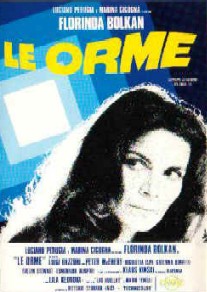
Footprints On The Moon AKA Le Orme (1975)
Justin takes a look back at a long-lost gialli from the director of THE FIFTH CORD...
FOOTPRINTS ON THE MOON is
the type of giallo that fits more neatly into the psychological thriller mould,
rather than the stalk-and-slash/black glove killer variety, where their motive
is usually an inheritance or just plain insanity. The film places you inside
the main character’s head, and asks: Is the paranoia all a sign of their
madness, or is it all really happening?
FOOTPRINTS ON THE MOON tries
to keep us in suspense about how our heroine will end up, and it all but fails
at this. Conversely, what saves the film, and why the viewer is drawn into to
watching, is down to the direction, cinematography, music, atmosphere, mood,
and the way these elements are brought together.
Alice Cespi (Florinda Balkan) is
translator who types notes for various scientists. She lives alone in a sleek,
sparse, but modern apartment. When we are introduced to her she gets up,
changes the date on her cube-shaped calendar, showers, makes coffee and gets to
work typing up notes for the current scientist she is assigned to. She then
picks up a friend from the airport on the way to work. While driving with
her friend, Alice tells her about the recurring dreams she has been having
concerning a man left on the moon by his fellow astronauts. She seems to think
it was a film she saw a long time ago.
After she drops her friend off, that is the
last we see of that character. She existed solely so Alice could relay the
exposition about her dreams to someone. Alice then proceeds to the office to
deliver the notes, where the secretary is quite short with her; telling her the
other translator had taken over for her and already turned in the notes. It is
then revealed that Alice has been gone for three days, yet she has no
recollection of this and thinks it’s just the next day.
She refuses to believe it
until the secretary points to the wall calendar to prove it.
Alice then leaves, with the future of her job in question. She has lunch with
another of her friends, Mary (Evelyn Stewart), who just like the previous
friend is pretty much there as a sounding board. While talking with Mary Alice
uncovers more memories of when she was at the conference three days prior,
translating the speaker’s language into English into a recorder: it’s here that
she undergoes a claustrophobic breakdown and runs out of one of the many
recording booths overlooking the auditorium and the science complex.
Alice returns home and meets her maid,
who asks about a grey dress that needs to be taken to the cleaners. They look
through the closet, but there is no grey dress to be found: however, there is a
yellow dress with a small spot of blood that neither of them remembers seeing
before.
That night, she tries to go to sleep and
envisions more black and white/sepia-toned scenes of Klaus Kinski as Dr.
Blackmann, who it is revealed is running an experiment of some sort involving
the abandoned astronaut, using extreme condtions to test emotional endurance,
panic, and fear.
Alice wakes up from the nightmare and
takes a tranquilizer, then brings out the ripped photo she found in her kitchen
trash bin that morning. (Apparently, the maid didn’t feel like emptying it that
day.) The photo is torn in four pieces that when put together show the exterior
of a beautiful luxury hotel.
She decides to go there and packs her
bags (including the yellow dress). She reaches the vacation island
of Gambra and some of the people even recognize her, even though she insists
this is the first time she has ever been there. It is around this point where
we get the feeling of “been there, seen that.”
Alice talks with a few people around the
hotel and beach resort, including little Paula (played by Nicoletta Elmi,
ubiquitous child star of ‘70s Italian horror) who, when Alice introduces
herself, claims that they have met before and Nicole is her real name.
Later , Paula says that she was
mistaken, as Nicole has long red hair and is mean and unpleasant. Alice also
talks to a older woman on the beach who might remember her and how Alice was
frightened by the barely visible silhouette of a man in the distance where the
woods meet the beach, not moving just watching her.
People give Alice tidbits of information
before clamming up – they then later shed a bit more light on what she did
or said those three days ago. Then there is the character of Peter, whom Alice
had met previously when she first stepped off the ferry. Are his intentions
good, or is he a part of her troubles? I won’t say, other than the resolution
of his storyline ends in yet another cliche.
The ‘mysterious’ items in the film
(i.e., the yellow dress, the yellow shoes, the long red wig, the gold comb),
while they may add credence to the ‘doppleganger’ theory, are just as quickly
dispersed of as the idea of a doppleganger
in general, because for all I could see there was very little emotional
difference between Alice and Nicole.
Alice is strident at times,
unsympathetic, cold (especially with Peter), to down right hysterical when
yanking on poor Nicole’s arm when she refuses to answer a question.
Balkan, while a good actress in certain
roles, was miscast for this film - the part needed someone with the ability to display
the emotional and mental turmoil Alice
goes through with only a facial expression or gesture. Actresses that may have
provided a better performance would have been Anita Strindberg, or perhaps
Rosella Falk.
The film’s saving grace are its visuals,
with the compositions and lighting being superb. The island is largely
desolate, which just adds to the general isolation and creepiness.
In an exterior shot, where Peter has
just dropped Alice off outside the hotel, the sky is a very dark blue. Night is
almost here. We immediately cut to the interior of the hotel. Our view is from
behind the front desk where an extremely bright round orange light dominates
most of the left part of the screen, with the manager in the mid-ground and
Alice in the back at the counter. This demonstrates not only the ability to
contrast light and dark tones, but also a knowledge of colors, as well as the
planes or layers you can use with the depth of field.
A similar image is when Alice is in her
hotel room changing her clothes: in the extreme foreground we have another
round light, glowing a yellowish orange. In the middle is the bed and standing
behind the bed, lined up with the light, with her face half blocked is Alice.
The rest of the hotel is also lit
beautifully, including the long, almost never ending corridors, and the immense
dining room. The beach has a grey gloomy sky in a few scenes, which again
contributes to a pervading sense of foreboding. Then there is Peter’s house,
with an amazing stained glass window of a crane, light glowing through every
multi-colored piece.
The very end of FOOTPRINTS ON THE
MOON comes so far out of left field that it is not so much that
it does not fit with what story they trying to to tell, but rather someone
said, “Okay, we have to end this thing. Still got those space suits?” It is
just plain goofy, and I forgive a lot when it comes to Italian genre cinema.
But not this.
Ultimately, I’d recommend spending your
money on a copy of THE FIFTH CORD by the same director
and cinematographer, as FOOTPRINTS ON THE MOON is
recommended only for gialli completists, fans of Luigi Bazzoi, and fans of
Vittorio Storaro.
Wednesday, 30 May 2012
Kaneto Shindo's Onibaba
Mere days before the BFI's retrospective is due to kick off, the sad news of director Kaneto Shindo's death is making waves across the web. But the man has left us with an amazing legacy and days of films to get lost in.
Here we look back at one of our favourites.

I was about sixteen years old and an interest in what lay outside the confines of Hollywood cinema had begun to grow in me; Japanese films held a particular allure for all the predictable reasons that would thrill a teenage mind from Kent – attractive young women from a very different culture being violent, anime like Akira, Ninja Assassin and Ghost in the Shell (with lots of blood / stuff blowing up), and the general cultural cache of being into cult and foreign movies (or what seemed exotic and underground in Canterbury circa 1998).

I can’t remember where exactly but, I had seen a still from Kaneto Shindo’s Onibaba and read a short review – I think it was the NME (yes, I used to read the NME) – and it was being shown very late on Channel 4 back in the days when Channel 4 still screened things worth watching. This was, of course, before the Film4 Channel, but even now you’re only likely to come across a film like this late night in the schedules after the 809th rerun of ‘Slumdog Millionaire’ that week.
The still, rather tragically, reminded me of the Fighting Fantasy book ‘Sword of the Samurai’ where they had, I retrospectively discovered, nicked the iconic demon mask image from Onibaba for one of their more memorable monsters.
I taped the film that night on my mum’s trusty VHS player and dutifully watched the film, slightly annoyed that I’d missed the first half hour due to various programming mistakes. I’d have to wait many years until the Criterion company, followed by Masters of Cinema in the UK, finally released a decent copy on DVD, so for years I was left with the slightly hazy impression of a wonderful film set entirely in swaying reed beds, sometime in feudal Japan during a vicious civil war, with two women in various states of undress murdering lost samurai, pushing them into a black hole and selling their weapons and armour to get by. Which, it turns out, is actually a rather large part of the film.

So years pass, I nearly forget about Onibaba but my interest in cinema in all its forms grows and grows, and when I see that demon-mask once more online, I get my hands on the aforementioned Criterion copy (early on I’d worked out the mysteries of multi-region DVD players) and watch Shindo’s art-house horror, properly, for the very first time.
I am glad to say that it held up to my teenage recollections. Existing in the grey area that makes a film sometimes appears too art-house to horror/cult fans, and too trashy for art-house cineastes, the film focuses on a middle aged woman and her daughter-in-law (whose husband has been killed during the war), who eke out a living in the reed beds from murder and theft. Then a man, Hatchi, arrives, a close friend of the young woman’s deceased husband. A sexual relationship begins to develop between them, threatening to destabilise and ruin the already tenuous relationship between the two women.
The older woman’s sexual jealously becomes, literally, a demonic force in this film; she becomes the very thing she warns the young woman about, personifying destructive lust and corrosive jealousy. Let us just say the demon-mask plays a crucial role in this.

Visually the film is stunning; in fact it is the most appealing thing about the picture, as the bare bones of the story are rather slender, loosely based on a simple Buddhist instructional tale.
But it’s all in the presentation, and the film’s lustrous black and white photography from director of photography Kiyomi Kuroda is beautiful, as is the marshland location which is as much a psychological landscape as anything; the swaying reeds are only punctuated by the river, the hut of the two women, and the infamous black hole. The setting adds a great deal of physical and metaphorical depth to the simple story, and the entirety of the drama plays itself out within this landscape, culminating in one of the most memorable endings in horror cinema that stayed with me even from my initial shaky VHS viewing all those years ago.

Kaneto Shindo has made many other films in his long career (he was born in 1912 and is still not dead), such as Children of Hiroshima, the strange feline ghost story Kuroneko (also available from Masters of Cinema), the remarkable, near silent analysis of Japanese island peasants in The Naked Island, before making a lot soft-core erotica during the pinku eiga era; but Onibaba remains his best and most recognisable film. Highly recommended.
Labels:
Gary Budden,
Masters of Cinema,
opines
Wednesday, 25 April 2012
INCOMING: Ti West's The Innkeepers
Cigarette Burns Cinema is proud to present a special preview screening of Metrodome Distribution's upcoming release THE INNKEEPERS. Originally premièring in the UK as one of the favourites of Frightfest's 2011 line up, The Innkeepers a modern classic as much as it is a homage to films before it.
Last Tuesday Society's Vadim Kosmos, takes a look -
Writer/Director/Editor Ti West has cultivated a recent reputation as a film maker who cares about craft; his ‘slow burn’ aesthetic in complete contrast to the current crop of lowest common denominator, attention deficient body count blockbusters and remake rehashes.
His attention to detail and the shimmering production values which emanate from his continued insistence to shoot on film, fly in the face of the post-Blair Witch “Found Footage” film trend.
Written while still licking his wounds from the tortured experience of writing/directing medium-major studio movie ‘Cabin Fever 2’; West was inspired by the uncanny events experienced by cast and crew while staying at the real life ‘Yankee Pedlar Inn' in Torrington, Connecticut - base camp for the location shoot of his previous indie production, the 80s Satanic period piece ‘House of the Devil’.
Fascinated by the ilk of TV’s ‘Most Haunted’, with its phoney psychics and their hi-tech honchos failing to uncover evidence of phantom phenomena on a weekly basis, West pondered how they would actually cope when confronted with the incontrovertible.
Written in three days, West’s script creates a convincing portrayal of that specific workplace chemistry of colleagues thrown together by necessity, but which rarely develops into any form of extra-curricular relationship. A scenario, which could have easily generated Kevin Smith-levels of annoyance, is instead deftly handled with a degree of unforced charm by the warm and natural performances of the appealing leads.
Tween movie star Sara Paxton, acting against glamorous type, imparts her character Claire with an unexpectedly awkward, goofy charm; while Pat Healy’s dryly-humoured cynicism fails to conceal his character Luke’s transparent and literally hopeless proximity-crush on the much younger woman.
The lives of the few remaining residents of the Hotel; a single mum, an elderly widower and a faded actress-turned-new-age-spiritualist give warning to the possible fates awaiting the duo if they continue their drifting lives. Kelly McGillis, as fallen movie star Leanne Rease-Jones (partially inspired by ‘House of the Devil’ co-star Dee ‘E.T.’, ‘The Howling’ Wallace), gives a slightly sour, but vulnerable performance one would not have predicted from her days in ‘Witness’ or ‘Top Gun’.
For a movie where the scares are as much heard as seen, it is fitting that much of the mood is via the mix created by sound designer Graham Resnick.
Minus the impossible architecture of Kubrick’s other famous haunted hotel, West creates an creeping anticipation of terror via slow dolly shots, pauses and clever framing - transforming the homey, rustic charm of the 19th Century hostelry into an environment where every innocent corner hides a wrongness.
Watch The Innkeepers with us at The Prince Charles Cinema on 24th May details here.
Saturday, 14 April 2012
THE KILLING OF SATAN (1983, PHILIPPINES) a.k.a LUMABAN KA, SATANAS
The Philippines has a cinematic history covering most of what you'd expect, but it's the truly mental excursions through the bizarre where it excels, from some of the more well know Eddie Romero classics and Roger Corman productions to the much loved midget spy For Y'ur Height Only.
But they don't stop there, oh no, the Philippines offerings only get more and more peculiar the deeper you dig.
Case in point - The Killing of Satan.
Dir. Efren C. Pinon
Written by: Joe Mari Avellana
One of the more imaginative Filipino Action/Fantasy/Exploitation films out there concerns Lando, a simple, mild-mannered guy who had served time in prison for killing a man that threatened his village. Free and now raising a family, Lando starts to receive messages in his dreams from his Uncle Miguel (the local Holy Man). When his daughter disappears, Lando is forced to join his his Uncle and his followers in their battle against Satan and his disciple, the Prince of Magic.
When three goons come into the village looking to kill Lando. While succeeding in shooting him, they also inadvertently kill his young son.
Lando is laid to rest in bed, recovering from a bullet wound in his head. While miles away on another island, Uncle Miguel is lying in bed as well, meditating... mentally absorbing Lando's mortal wounds into his own head saving Lando in the process.
Now recovered, our hero is drawn to the island by the chanting of his Uncle's devout followers. He, his wife, and his daughter Louisa set forth across the short distance of sea. Heavy, foreboding winds pick up out of nowhere, trying to impede their progress. They make it to the beach and are met by a strange, mute child who leads them across rocky terrain. The top of the cliff explodes, showering boulders upon them. The is forced to take cover, when the dust clears, the mysterious child has vanished.
Lando and family are greeted at the village and he is told by Renzo (the second most powerful Magician in the village) that his Uncle has died from a bullet wound, however, he had not been shot.
Renzo leads Lando to the shore where his Uncle was buried at sea. Lando rows out, stops, grasping his head in pain from some sort of psionic attack. Shaking it off and continues on. A piece of driftwood bumps the boat. He pushes it away. It floats back. When Lando reaches for it this time, a rotten, grey-skinned hand grabs his arm, and a decomposed corpse bursts out of the water and says in a horrifying voice, "I am your Uncle Miguel!" Only to disappear back into the water. It is some pretty jolting stuff.
While Renzo and Lando are still at the shore, the Prince of Magic and his underlings raid the village for girls. They use their hypno-wheel, magic hand blasts and psionic staring contests to take down the men and carry off the women including Lando's daughter Louisa. The power duo Lando and Renzo return to the village to find the few remaining baddies still left. Renzo instructs Lando to use his hitherto unknown powers, creating a swirling force field from his arm to deflect bullets as well as becoming invincible to the underlings' fisticuffs while his punches do supreme damage. He soon discovers he can use his newfound powers to heal the injuries his wife had sustained when the village was attacked.
Left with no option but to travel to where servent of Satan, the Prince of Magic dwells, Lando and Renzo must rescue Louisa. Who is being held captive in a cave in an electrified cage full of naked women. Lando fights off the Snake Man and lower henchmen of the cave only to face the Prince of Magic himself. But is overtaken before he can activate his powers and is thrown off a waterfall by the minions.
Lando floats unconscious down a river until he comes to a stop at a shore where the little boy from earlier, Nino is waiting. Nino leads him to a small, crumbling stone church where there is an old man (God ?) with long white hair and a beard. He gives Lando a magic staff that, along with Lando's own powers, will be able to destroy Satan.
With that, Lando treks back to the cave to fight the Prince of Magic, temptation used by Ava, the Sexy Snake Woman; and finally Satan himself, to save his daughter.
THE KILLING OF SATAN is certainly a fun film. A horror cartoon come to life with sufficient f/x, goofy costumes, and some cool/surreal images i.e. the aforementioned corpse popping out of the water, clear waterfalls turning into blood, the pulsar shields and firing of magic energy from one's hands, and most notably the sequence where a character is completely rolled over by a boulder revealing his body to be a red, pulpy mess only for his head to go right on talking.
With all this going on how could you not like this movie?
By
JUSTIN HUGH DICKINSON
Read more of Justin's wanderings through dusty VHS racks on his OPERATION: 24fps blog.
Monday, 9 April 2012
Ice Cream Trucks and Dwarves
It's been a while, so why not return with an undisputed classic? One that is close to many people's hearts, and certainly deserves a revisit - Phantasm
Director Don Coscarelli etches something as close to a real-life nightmare as you are likely to witness on screen. A heroically-bizarre movie including metallic flying-spheres drilling blood-spattered holes in heads and a magical gateway to a sand-ridden planet populated by not just alien but dwarf slaves. 'Phantasm' is an energised cinematic jolt of low-budget horror fantasy.
The plot, if you can call it that, involves a young boy (A Michael Baldwin) and his older brother (Bill Thornbury) who find out that there are very strange goings-on - somewhat akin to body-snatching but suitably crazier - at their local funeral home. The stolen corpses are somehow transformed into the aforementioned undead dwarf slaves in order to serve some alien God...... Of course, at the centre of it all is the mysterious and by now, cult figure, the 'Tall Man' played by the omnipresent Angus Scrimm. Our good guys are completed with the inclusion of a hilarious middle-aged ice-cream vendor and wannabe rock-singer 'Reggie' (Reggie Bannister) - and yes, there is a musical number in here...... Strange enough for you yet?
Whilst certainly not for everyone (particularly if you're the kind of viewer who likes to know what is going on), and if you can forgive the production values and performances, "Phantasm" is cripplingly joyous entertainment leaving you with a genuine sense of awe for the imagination of Coscarelli and co. The movie runs at one hell of a pace and is infamous for the 'head-drilling' sequence alone, but there is more to savour than the short 88 minute running time would suggest - including a script swollen with cheese, over-acting, motorbikes and achingly unsubtle testosterone.
Australian Lobby Card
Although not as scary as the tagline -"If this one doesn't scare you, you're already dead!" - indicates, there are nevertheless some heart-pounding moments and more than a dusting of 'cheap' shocks (bodies falling out of cupboards, etc.). There's also a fantastic chase sequence between a hearse, or more like an evil-version of the bat-mobile to be honest, and a motorbike.
Coscarelli's vision is lovingly propelled throughout by an eerie score reminiscent of 'Tubular Bells' but along with the 'Carrie'-esque ending, is where the 'borrowing' ends - "Phantasm" is a uniquely fascinating movie, directed with panache and original to the point that it could never be understood, let alone forgotten - just like a nightmare.
Grant Davies covers similar B grade classics as well as Westerns at his Hot Dog Cinema blog
Labels:
review
Saturday, 26 November 2011
Christmas Evil aka You Better Watch Out
"What's this all about then? A film that's never had proper distribution in the UK? I've never heard of it."
Or perhaps you've heard whispers of it. But trust us when we say this is a magical little holiday film, sitting solidly in many, many people's Top 5 Christmas Films List. Including yours truly's, but don't take my word for it, one John Waters has gone on record stating he'd screen this film at every Waters Christmas Dinner, that's how highly he rates it.
But Cigarette Burns is about bringing you flicks, that for whatever reason you've not seen, but really really ought to. If only so you can cherish them as much as we do. So with that in mind, you can't imagine how excited we are to present the UK première of Christmas Evil, with an iQ&A with director Lewis Jackson hosted by Kim Newman at the Prince Charles Cinema on 7th December.
When those winter nights draw in and the seasonal chill burrows into our bones; when all throughout the house no creatures stir, not even the mouse; we know this can mean but one thing... Saint Nick is coming.
However, the gift-wrapped toys that sit under the evergreen are, undeniably, by-products of selfishness and deceit that we happily pass on to the younger generation. And when the holidays roll around, so do the opportunistic slasher or creature features, riding the coattails of whatever holiday hype they can to help push their tat. More often than not, this results in less than favourable results.
There have been rare exceptions over the years: gems such as Bob Clark’s early slasher Black Christmas, the brilliant Finnish production Rare Exports and the criminally overlooked Sheitan, starring Vincent Cassel. But none explore the dangers of truly deceiving our children. The innocent children, susceptible to the tales we adults tell them; susceptible to our lazy, disdainful and self-interested ways; these are the darker kinds of realities that the Saint Nick fable perhaps could and should show us.
Which brings us to Lewis Jackson’s dark and twisted, yet frighteningly clear-eyed Christmas Evil, or, as he’d prefer it to be known, You Better Watch Out. In which our... hero? Harry Standling (played to perfection by Brandon Maggart, none other than Fiona Apple’s father - yeah, go figure) struggles with his inner demons and ultimately, his own inner Santa Claus. One who is kind to the good, but vengeful and angry when faced with those whose hearts are a little less full and caring than perhaps they should be during the Season of Giving.
Jackson’s You Better Watch Out was clearly a project full of passion and drive; in many ways he seems as single minded in his creation as Harry does in his invocation of Santa Claus. After struggling through a difficult underfunded production, the film was ultimately ripped from Jackson’s hands by unscrupulous producers, retitled and relegated to the bottoms of the VHS pound bins - forgotten and deemed as valueless as copper, like lost change down the back of your sofa. But in recent years Jackson revisited his 30 year old property and reclaimed it as his own. He battled the courts and greedy execs, earning the right to present the film as he originally wanted, dreamed and shot it. As the title says, it seems You Better Watch Out.
With his third directorial effort, Jackson released on the world an anarchic retaliation to the simplistic capitalistic ideologies to be found in the average Christmas fable. Inspired byTiticutt Follies and German expressionist classics like M, whilst throwing in a soundtrack by NYC No Wave faces James Chance's the Contortions, You Better Watch Out is easily one of the best Christmas films, more American Psycho than Silent Night, Deadly Night. It’s no wonder that John Waters claims it’s his favourite Christmas flick ever.
Check out the Facebook Event page Here
And get your tickets Here
Tuesday, 15 November 2011
SILENT RUNNING: Blu-ray review
It’s somewhat unlikely that SILENT RUNNING should arrive on
Blu-ray with something akin to the fanfare of a returning hero, as it’s always
been a film that’s existed in the shadow of its bigger, more serious brother,
2001: A SPACE ODYSSEY. But thanks to some pretty high profile name-checking
from some of this generation’s most successful and prominent sci-fi film-makers
(Andrew Stanton and Duncan Jones to name two) and a consistent and heartfelt
championing from Mark Kermode (who argues that the film is actually superior to
the more traditionally critically-vaunted 2001) means that SILENT RUNNING is
now slowly achieving the kind of attention from critics and audiences that its
fervent supporters have always argued it should.
Set in a not-so distant future where rising temperatures have
led to the extinction of all plant life on earth, the film takes place on the Valley Forge, an enormous space freighter where the
remainder of Earth’s forests are being held in bio-domes. The Valley
Forge is populated by a skeleton crew of four, the majority of whom
are bored rigid and eager to return home. The exception is Lowell Freeman
(Bruce Dern), the man tasked with maintaining the forests – highly strung and
with an extremely close bond to plants and nature, Freeman believes religiously
in the importance of his work, and fervently anticipates the day when the
forests can be returned to Earth and replanted.
When the order comes through from high command to destroy
the forests in a cost-cutting measure, Freeman snaps, and risks everything in
order to keep man’s last links to nature alive, enlisting along the way as help
three adorable service robots, nicknamed Hewey, Dewey, and Louie.
Comparisons with 2001 are always going to be inescapable for
SILENT RUNNING - partly because they’re two of the most high profile ‘space’
science fiction movies ever made, released within a couple of years of one
another - but mainly because of the shared involvement of Douglas Trumbull. Trumbull provided the
groundbreaking visual effects in Kubrick’s film, whereas on SILENT RUNNING he was
also responsible for script and directing duties.
Trumbull himself has noted that SILENT RUNNING was in effect
conceived as a rejoinder 2001’s cold, clinical vision of science fiction, and Trumbull’s film is likely
to surprise first-time viewers with its earnest, unabashed sentimentality. There
is a child-like quality about the whole film – about Hewey, Dewey and Louie,
about Freeman’s idealism, even the way the crew race around on those
fun-looking modified go-karts – and it’s telling that SILENT RUNNING’s biggest
fans are those who saw the film at a young age. Those of us cynical adults who
have grown up on ALIEN, MOON, SUNSHINE and the DEAD SPACE video games and, yes,
even 2001 might find SILENT RUNNING’s PG
rated version of space madness a little toothless and insubstantial, and the
scenes of Freeman making friends with the robots somewhat mawkish, particularly
in conjuction with Joan Baez’s hippy-dippy songs, which are just as likely to
make you want to put your foot through the TV as enchant you.
As a story, ultimately SILENT RUNNING doesn’t really hang
together – the dialogue is occasionally overwrought, and there are some pretty
huge plot holes (how can someone be aware of Duck Tales yet not the fact that
plants need sunlight?). There are also big pacing problems – there are large
swathes of the film where very little happens, and while SILENT RUNNING
certainly wouldn’t benefit from shoe-horning in of an action sequence, there
are a few patience testing moments and the film feels a lot longer than its
modest 90 minute running time.
Despite its many flaws, there’s lots to love about SILENT
RUNNING. Firstly there’s Bruce Dern’s incredible performance as Freeman, all
twitching intensity and wild-eyed prophesising. He looks and sounds like
someone who would collar you at a Grateful Dead concert to tell you about The
Man putting fluoride in the water supply, and as such is unique in the history
of cinematic spacemen. When asked about the genesis of the character Trumbull brilliantly said
(I’m paraphrasing here) “Hey, there’ll be weird people in the future too.”
The reason that SILENT RUNNING has proved so enduring,
however, is certainly down to it’s world, conceived entirely with ingenious
practical effects before the advent of CGI, and still standing up to scrutiny
today. While 2001 may be regarded as the better film, there’s definitely a case
for SILENT RUNNING being the more influential, particulary in the realm of hard
science fiction. The Valley Forge seems like
an early prototype for the Nostromo; Wall-E’s whole aesthetic borrows heavily
from the whole film, as well as Wall-E himself being clearly descended from
Huey, Dewey and Louie, not to mention R2-D2; and the bored spaceman railing
against the man was replicated to great effect in MOON. And we may never have
seen RED DWARF or MYSTERY SCIENCE THEATER 3000 if it didn’t have the template
of robots and humans awkwardly bonding on a spaceship to replicate.
The ingenuity that went into the design of the ‘miniatures’
(the Valley Forge model was 26 feet long), the sets and particularly the robots
(in a genius move, the robots were portrayed by double amputees, giving the
machines a real tactile weight and personality) mean that the world of SILENT
RUNNING is still as exotic, realised and convincing as it was 40 (!) years ago.
There’s no denying that while some moments are overwrought the film does still
pack quite an emotional punch, with the plight of Freeman and the robots and the
ultimate fate of the Valley Forge being
genuinely moving and thought-provoking. There's no doubting that Trumbull is heartfelt about his film and its 'message', and for all its meandering he still crafts a powerful and heartbreaking final shot that is one of
the most memorable in all of science fiction.
It’s also great to see a sci-fi film that is so colourful –
so often sci-fi has a washed-out, sterile palette, but SILENT RUNNING is
rendered in vibrant, colourful detail, with the primary colours of the Valley
Forge rec room and Freeman’s space suit, alongside the lush greens of the
forest really brought out by Masters of Cinema’s magnificent, razor-sharp
transfer.
The Blu-ray represents another winning effort for Eureka and the Masters of
Cinema label, with benchmark sound and picture quality that is at very least
the best the film has looked since its original 35mm release. Also included is
a fascinating, 60 minute documentary on the making of the film from 1972,
alongside substantial interviews and a commentary with the always engaging
Trumbull and Dern. There’s also a glossy 48-page booklet packed with photos,
interviews and concept artwork, rounding out an extremely impressive release of
a flawed yet seminal film.
Follow me on Twitter: @paulmartinovic
Subscribe to:
Posts (Atom)